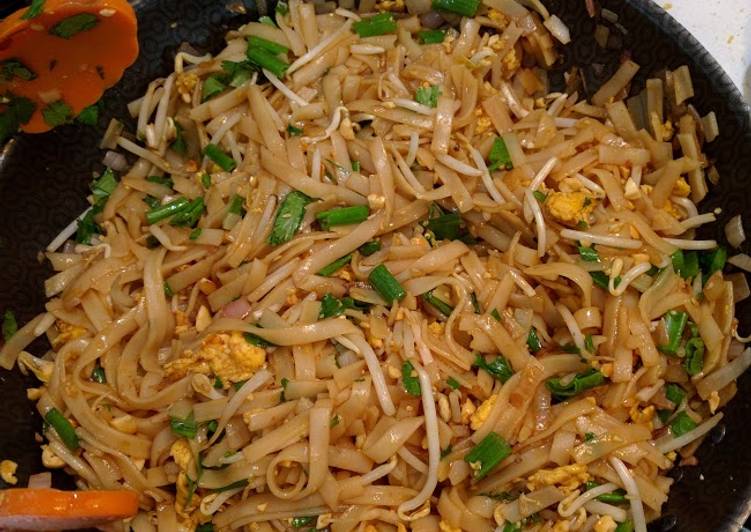
Hey everyone, it is John, welcome to our recipe page. Today, I’m gonna show you how to make a special dish, pad thai. One of my favorites. For mine, I’m gonna make it a bit tasty. This is gonna smell and look delicious.
Pad Thai is one of the most favored of recent trending meals in the world. It’s simple, it is quick, it tastes delicious. It’s appreciated by millions every day. They’re nice and they look wonderful. Pad Thai is something which I’ve loved my entire life.
Pad thai, or phad thai, is a stir-fried rice noodle dish commonly served as a street food and at most restaurants in Thailand as part of the country's cuisine. Poo's back FoodTubers and this time she's got a classic Pad Thai recipe to share with you. Fresh juicy prawns stir fired with tofu, crunchy veg and egg.
To get started with this particular recipe, we have to prepare a few ingredients. You can cook pad thai using 17 ingredients and 12 steps. Here is how you cook it.
The ingredients needed to make Pad Thai:
- Make ready 250 gr Thai noodles
- Make ready 2 tbsp sesame oil
- Prepare 2 tbsp olive oil
- Make ready 3 eggs
- Make ready 20 small shrimps
- Get 2 cloves garlic; chopped
- Prepare 1/4 cup shallots; chopped
- Take 1 tbsp furikake
- Prepare 2 tbsp rice vinegar
- Take 4 tbsp soy souce
- Make ready 2 tbsp brown sugar
- Get 2 tbsp lemon juice
- Make ready 2 tbsp sriracha
- Prepare 1 cup bean sprouts
- Get 1/2 cup crushed peanuts
- Take 1/4 cup green onion (tails, sliced in 1 cm parts)
- Take 1/4 cup cilantro
This restaurant-quality Pad Thai recipe is surprisingly easy to make at home and customize with whatever noodles, proteins, veggies, and spice level you prefer. It starts with fresh ingredients including rice noodles, chicken, shrimp, tofu, cilantro, bean sprouts. Pad Thai is believed to have originated in Thailand during World War II. It was born out of a combination of a rice shortage and Thailand's prime minister wanting to create a national dish.
Instructions to make Pad Thai:
- Cook the noodles in boiling water for 5-7 minutes, until done.
- Rinse and add 1/2 tbsp of sesame oil. Stir. Then separate and save for later.
- After cleaning them, cook the shrimps in boiling water for 2.5 to 3 minutes.
- Heat the 2 tbsp of olive oil in a large pan and add the chopped garlic.
- Fry the already boiled shrimps for 1 minute, more or less. Then separate and save for later.
- Scramble the 3 eggs and cook them in a pan, like normal scrambled eggs. Then separate and save for later.
- Before putting the Pad Thai together, let's make the Pad Thai sauce: add the soy sauce, the rice vinegar, the furikake, the brown sugar, the lemon juice and the sriracha in a container and mix well, until the sugar is dissolved.
- On a large pan or wok add the rest of the sesame oil and the chopped shallots. Cook them until brown.
- Add the cooked noodles and stir to mix with the shallots.
- Add the scrambled eggs and the shrimps, and stir again to mix.
- Add the Pad Thai sauce you prepared in step 7 and stir.
- Finally, just before serving, add the bean sprouts, the cilantro, the green onion tails and the crushed peanuts. Give the final stir and serve.
Pad Thai - This Pad Thai recipe is how you actually find it in Bangkok and comes from testing hundreds of different variations from food carts all over the city. Pad Thai is stir-fried rice noodle dish ubiquitous with Thai cuisine in the United States, but it wasn't With World War II nearing, the Thai government created the dish to promote a sense of national unity. This is a traditional Pad Thai recipe used by a friend's mother. You can use chicken, pork, beef, tofu, or a combination. You may want to start with less pepper, and work your way up.
So that is going to wrap this up with this special food pad thai recipe. Thanks so much for reading. I am sure that you can make this at home. There’s gonna be interesting food in home recipes coming up. Don’t forget to save this page on your browser, and share it to your loved ones, colleague and friends. Thanks again for reading. Go on get cooking!